

Loop handle bag
These bags are made with at least 70% post-consumer recycled plastic, which comes from waste generated after the original product has been used.
The carbon footprint resulting from the production, transport, and distribution of these bags has been calculated and offset.
How are these bags produced?
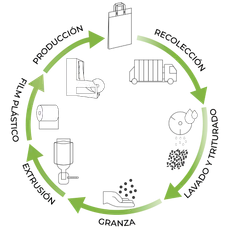
First, used plastic products are collected and sorted according to their type. Then, they are washed and shredded, and subsequently melted into small fragments called pellets. The pellets are fed into an extruder machine that, through a blowing and temperature control system, generates a sheet of recycled plastic. This sheet is then printed and cut to create the new bag.
How have we calculated their carbon footprint?
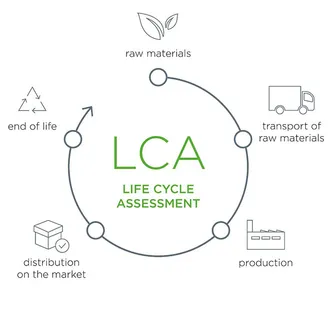
To calculate the carbon footprint, we follow an international standard called ISO 14067. This standard defines how to calculate and manage the carbon footprint generated throughout the product’s entire process—from the selection of materials used, through manufacturing, to the transportation of the final product. We review everything with the help of external auditors to ensure the calculation is objective, valid, and accurate.
This allows us to offer a real carbon footprint figure, reflecting our commitment to environmental care.
Carbon footprint offset
We are committed to environmental care. As part of this commitment, we monitor, reduce, and offset our carbon footprint across all our processes. These 100% recycled plastic bags are traceable throughout their production cycle. Below, you can see all the CO2 offsets associated with each stage of their cycle.
The carbon footprint resulting from the production, transport, and distribution of these bags has been offset through a climate action project, resulting in a net-zero emissions impact.
These bags are made with at least 70% post-consumer recycled plastic, which comes from waste generated after the original product has been used.

| Batch | Manufacturing date | SKU | Quantity | Emitted tons | Offset tons | Certificates | Project ID | Offset project |
|---|---|---|---|---|---|---|---|---|
| POPSP24-000186 | 19/12/2024 | Metro | 670.400 | 28,93 | 28,93 | BAM Madre de Dios Amazon REDD+ Project | 868 | BAM Amazon Forests in Peru |
| POPSP24-000186 | 8/11/2024 | Wong | 744.400 | 32,09 | 32,09 | BAM Madre de Dios Amazon REDD+ Project | 868 | BAM Amazon Forests in Peru |
| POPSP25-00031 | 07/03/2025 | Metro | 680.400 | 29,36 | 29,36 | BAM Madre de Dios Amazon REDD+ Project | 868 | BAM Amazon Forests in Peru |
| POPSP25-00031 | 05/03/2025 | Wong | 703.200 | 30,31 | 30,31 | BAM Madre de Dios Amazon REDD+ Project | 868 | BAM Amazon Forests in Peru |
Great Packaging, in collaboration with an international certifying body, has carried out and audited a rigorous calculation of the carbon emissions generated during the production and transport of the products listed in the table above, accrediting and certifying these emissions.
As part of our environmental commitment, we offset these emissions by transferring carbon credits to the client through the project indicated in the table above.
With this action, Great Packaging reinforces its social and environmental responsibility alongside its clients, supporting projects that not only preserve ecosystems but also boost the economic and social well-being of local communities, promoting a sustainable development model aligned with global sustainability challenges.
Product certifications